














On Sale
25% OFF
RRP $334.00
Now Open 12pm - 5 pm on Sundays!
 Guitars
 Strings
 Percussion
 Digital Piano
 Folk & Ukuleles
 Brass
Brass
 Woodwind
 Orchestral Strings
 Pro Audio & Studio

 DJ Equipment
 Drum Pedals
 Lighting
 Staging
Guitars
Strings
Percussion
Digital Piano
Folk & Ukuleles
Brass
Woodwind
Orchestral Strings
Pro Audio & Studio
DJ Equipment
Drum Pedals
Lighting
Staging
Staging
Guitars
Strings
Percussion
Digital Piano
Folk & Ukuleles
Brass
Woodwind
Orchestral Strings
Pro Audio & Studio
DJ Equipment
Drum Pedals
Lighting
Staging

In violin making, few components influence the instrument's voice as profoundly as the bridge. It is the single point through which all string vibration is transmitted to the body — a piece of maple no larger than a thumb that determines tone, response, projection and playability in ways that no other adjustment can replicate. For over 150 years, one name has been synonymous with the finest violin bridges in the world: Aubert of Mirecourt.
At Angkor Music Melbourne, we stock the full range of Aubert bridges and fit them as standard on every instrument that leaves our workshop. We are an authorised Aubert dealer and our team has hands-on experience fitting and voicing Aubert bridges across instruments ranging from fractional student violins to professional instruments of considerable value.
At Angkor Music we fit Aubert bridges as standard across our violin range — from the St Romani III student outfits through to the Gliga I premium instruments. This is not an accident or a commercial arrangement. It is a deliberate choice based on years of workshop experience. A properly fitted Aubert bridge consistently produces a more responsive, tonally richer result than generic alternatives at every price point. The quality of the maple, the precision of the cut and the consistency of the graduated thickness make fitting an Aubert bridge a reliable path to a better sounding instrument. We recommend them without hesitation.
To understand why an Aubert bridge matters, it helps to understand where it comes from. Mirecourt is a small town in the Vosges region of northeastern France that has been at the centre of European violin making and lutherie supply for over four centuries. At its peak in the 19th century, virtually every component of every violin made in Europe — bridges, tailpieces, pegs, cases, rosin — passed through Mirecourt workshops.
The Aubert family established themselves in Mirecourt as bridge makers of exceptional quality and their reputation has endured through generations of makers, players and workshops worldwide. When a luthier in Tokyo, a violin teacher in Melbourne or a professional player in Vienna reaches for a bridge blank, the Aubert name is the reference point against which all others are measured.
Not all violin bridges are equal — and the difference between a quality bridge and a cheap one is immediately audible and tactile to any experienced player or teacher. The Aubert bridge earns its reputation through several specific qualities:
Aubert sources its bridge maple — Acer pseudoplatanus — from carefully selected European forests, with particular emphasis on the hardness, grain density and moisture content of each piece. Bridge maple must be neither too hard nor too soft — too hard and it transmits vibration harshly, too soft and it absorbs rather than transmits energy. Aubert's timber selection and seasoning process produces maple of consistent, ideal density — a quality that is immediately felt in the response and tone of the finished instrument.
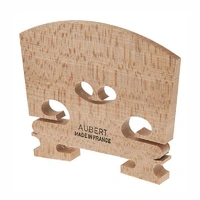
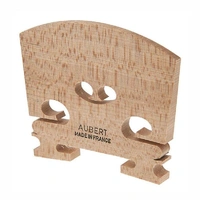
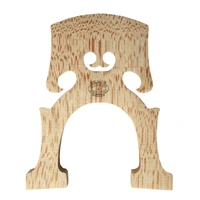
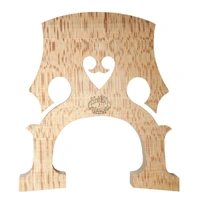
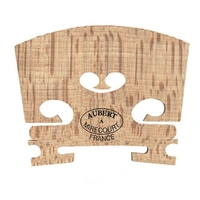
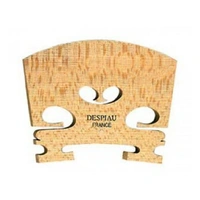
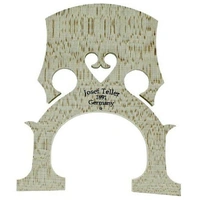
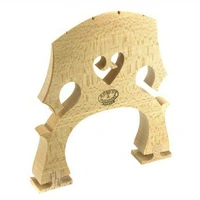
A bridge blank from Aubert begins at a consistent, calibrated thickness and graduation. The heart of the bridge — the central kidney-shaped cutout — is sized and positioned to optimise the balance between structural rigidity and acoustic flexibility. The feet of the bridge are shaped to maintain broad, even contact with the top of the violin, transmitting vibration uniformly rather than concentrating it at two points. These are details that a cheap bridge ignores and an Aubert bridge gets right every time.
Every Aubert bridge blank arrives from Mirecourt with a consistent, repeatable profile — giving a skilled luthier a reliable starting point for the final fitting. The consistency between blanks means that a luthier who has fitted one hundred Aubert bridges knows exactly what to expect from the one hundred and first. This predictability is not a small thing — it is the foundation of reliable, repeatable workshop results.
Aubert produces bridges across a range of grades, each appropriate to a different level of instrument. At Angkor Music we stock the full range — from the student grades fitted to our St Romani and Gliga III outfits through to the premium aged maple grades used on our Gliga I instruments. Understanding the grades helps you make the right choice for your instrument:
The entry level Aubert bridges provide the same quality maple and consistent profile as the premium grades — the difference is in the degree of pre-finishing. Student grade Aubert bridges are fitted to our St Romani and Gliga III outfits as standard. They represent a significant acoustic improvement over the generic bridges supplied with most student instruments and are the reason our student outfits sound notably better than competitors at the same price point.
The Aubert aged maple bridge is the grade fitted as standard to our Gliga II and St Romani II instruments — and the grade recommended by luthiers worldwide as the best value to quality bridge available. The additional ageing process allows the maple to reach optimal density and resonance characteristics before being cut into blanks. The result is a bridge that transmits vibration with a clarity and immediacy that is immediately audible — tighter fundamental response, cleaner harmonics and a more focused tone across all four strings.
This is the bridge that transforms a good student instrument into a noticeably better one. It is also the first upgrade we recommend to any player who brings their violin into our workshop for a setup — fitting an Aubert aged maple bridge is one of the most cost-effective acoustic improvements available for any violin.
The premium Aubert grades — including the Luxe and specialist cuts — are used on instruments of corresponding calibre. At this level the maple selection is the finest available, the ageing is longer, and the graduation of the blank is more precisely controlled. These bridges are fitted to our Gliga I instruments and are the grade of choice for professional instruments brought into our workshop for setup and optimisation.
The finest Aubert bridge in the world will not perform to its potential if it is not properly fitted. This is one of the most important things we communicate to customers who purchase bridges from us.
A violin bridge must:
At Angkor Music our workshop team fits every bridge sold through our violin instruments before dispatch. For players who purchase a bridge blank for fitting to their existing instrument, we offer professional fitting services at our Altona workshop. A bridge fitted by our team will be voiced and adjusted specifically for your instrument — not simply placed on top of it.
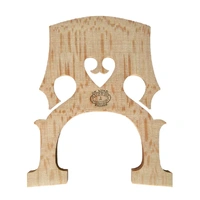
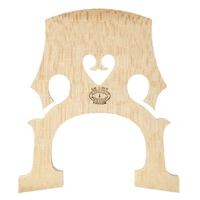
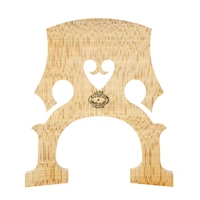
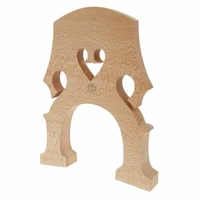
We stock Aubert bridges for violin across the full size range — 4/4, 3/4, 1/2, 1/4 and smaller fractional sizes. We also stock Aubert bridges for viola and cello. If you are looking for a specific grade or size that is not showing as available online, please contact us — our workshop team can advise on the correct grade for your instrument and arrange supply.
For players bringing their instrument to our Altona workshop for a setup or bridge fitting, we recommend calling ahead to confirm stock of your preferred grade and to book a workshop appointment.
There are other bridge makers. Some produce excellent bridges. But in over two decades of workshop experience across hundreds of student and professional instruments, the Aubert bridge — particularly the aged maple grades — has proven itself the most consistently reliable path to a better sounding, better responding violin across every price category. It is the bridge fitted to every instrument that leaves our workshop. It is the bridge we recommend to every player who asks.
That recommendation is not commercial. It is experiential. It comes from fitting bridges, hearing the difference, and trusting the result.
★★★★★ 4.9 Stars — Read Our 1,500+ Google Reviews →
★★★★★ 4.9 Stars — Over 1,500 Google Reviews → ✓ Happy with your purchase? Leave us a review →
In violin making, few components influence the instrument's voice as profoundly as the bridge. It is the single point through which all string vibration is transmitted to the body — a piece of maple no larger than a thumb that determines tone, response, projection and playability in ways that no other adjustment can replicate. For over 150 years, one name has been synonymous with the finest violin bridges in the world: Aubert of Mirecourt.
At Angkor Music Melbourne, we stock the full range of Aubert bridges and fit them as standard on every instrument that leaves our workshop. We are an authorised Aubert dealer and our team has hands-on experience fitting and voicing Aubert bridges across instruments ranging from fractional student violins to professional instruments of considerable value.
At Angkor Music we fit Aubert bridges as standard across our violin range — from the St Romani III student outfits through to the Gliga I premium instruments. This is not an accident or a commercial arrangement. It is a deliberate choice based on years of workshop experience. A properly fitted Aubert bridge consistently produces a more responsive, tonally richer result than generic alternatives at every price point. The quality of the maple, the precision of the cut and the consistency of the graduated thickness make fitting an Aubert bridge a reliable path to a better sounding instrument. We recommend them without hesitation.
To understand why an Aubert bridge matters, it helps to understand where it comes from. Mirecourt is a small town in the Vosges region of northeastern France that has been at the centre of European violin making and lutherie supply for over four centuries. At its peak in the 19th century, virtually every component of every violin made in Europe — bridges, tailpieces, pegs, cases, rosin — passed through Mirecourt workshops.
The Aubert family established themselves in Mirecourt as bridge makers of exceptional quality and their reputation has endured through generations of makers, players and workshops worldwide. When a luthier in Tokyo, a violin teacher in Melbourne or a professional player in Vienna reaches for a bridge blank, the Aubert name is the reference point against which all others are measured.
Not all violin bridges are equal — and the difference between a quality bridge and a cheap one is immediately audible and tactile to any experienced player or teacher. The Aubert bridge earns its reputation through several specific qualities:
Aubert sources its bridge maple — Acer pseudoplatanus — from carefully selected European forests, with particular emphasis on the hardness, grain density and moisture content of each piece. Bridge maple must be neither too hard nor too soft — too hard and it transmits vibration harshly, too soft and it absorbs rather than transmits energy. Aubert's timber selection and seasoning process produces maple of consistent, ideal density — a quality that is immediately felt in the response and tone of the finished instrument.
A bridge blank from Aubert begins at a consistent, calibrated thickness and graduation. The heart of the bridge — the central kidney-shaped cutout — is sized and positioned to optimise the balance between structural rigidity and acoustic flexibility. The feet of the bridge are shaped to maintain broad, even contact with the top of the violin, transmitting vibration uniformly rather than concentrating it at two points. These are details that a cheap bridge ignores and an Aubert bridge gets right every time.
Every Aubert bridge blank arrives from Mirecourt with a consistent, repeatable profile — giving a skilled luthier a reliable starting point for the final fitting. The consistency between blanks means that a luthier who has fitted one hundred Aubert bridges knows exactly what to expect from the one hundred and first. This predictability is not a small thing — it is the foundation of reliable, repeatable workshop results.
Aubert produces bridges across a range of grades, each appropriate to a different level of instrument. At Angkor Music we stock the full range — from the student grades fitted to our St Romani and Gliga III outfits through to the premium aged maple grades used on our Gliga I instruments. Understanding the grades helps you make the right choice for your instrument:
The entry level Aubert bridges provide the same quality maple and consistent profile as the premium grades — the difference is in the degree of pre-finishing. Student grade Aubert bridges are fitted to our St Romani and Gliga III outfits as standard. They represent a significant acoustic improvement over the generic bridges supplied with most student instruments and are the reason our student outfits sound notably better than competitors at the same price point.
The Aubert aged maple bridge is the grade fitted as standard to our Gliga II and St Romani II instruments — and the grade recommended by luthiers worldwide as the best value to quality bridge available. The additional ageing process allows the maple to reach optimal density and resonance characteristics before being cut into blanks. The result is a bridge that transmits vibration with a clarity and immediacy that is immediately audible — tighter fundamental response, cleaner harmonics and a more focused tone across all four strings.
This is the bridge that transforms a good student instrument into a noticeably better one. It is also the first upgrade we recommend to any player who brings their violin into our workshop for a setup — fitting an Aubert aged maple bridge is one of the most cost-effective acoustic improvements available for any violin.
The premium Aubert grades — including the Luxe and specialist cuts — are used on instruments of corresponding calibre. At this level the maple selection is the finest available, the ageing is longer, and the graduation of the blank is more precisely controlled. These bridges are fitted to our Gliga I instruments and are the grade of choice for professional instruments brought into our workshop for setup and optimisation.
The finest Aubert bridge in the world will not perform to its potential if it is not properly fitted. This is one of the most important things we communicate to customers who purchase bridges from us.
A violin bridge must:
At Angkor Music our workshop team fits every bridge sold through our violin instruments before dispatch. For players who purchase a bridge blank for fitting to their existing instrument, we offer professional fitting services at our Altona workshop. A bridge fitted by our team will be voiced and adjusted specifically for your instrument — not simply placed on top of it.
We stock Aubert bridges for violin across the full size range — 4/4, 3/4, 1/2, 1/4 and smaller fractional sizes. We also stock Aubert bridges for viola and cello. If you are looking for a specific grade or size that is not showing as available online, please contact us — our workshop team can advise on the correct grade for your instrument and arrange supply.
For players bringing their instrument to our Altona workshop for a setup or bridge fitting, we recommend calling ahead to confirm stock of your preferred grade and to book a workshop appointment.
There are other bridge makers. Some produce excellent bridges. But in over two decades of workshop experience across hundreds of student and professional instruments, the Aubert bridge — particularly the aged maple grades — has proven itself the most consistently reliable path to a better sounding, better responding violin across every price category. It is the bridge fitted to every instrument that leaves our workshop. It is the bridge we recommend to every player who asks.
That recommendation is not commercial. It is experiential. It comes from fitting bridges, hearing the difference, and trusting the result.
★★★★★ 4.9 Stars — Read Our 1,500+ Google Reviews →
★★★★★ 4.9 Stars — Over 1,500 Google Reviews → ✓ Happy with your purchase? Leave us a review →

Australian Business

Fast and Free Delivery

Easy Returns

Expert Knowledge